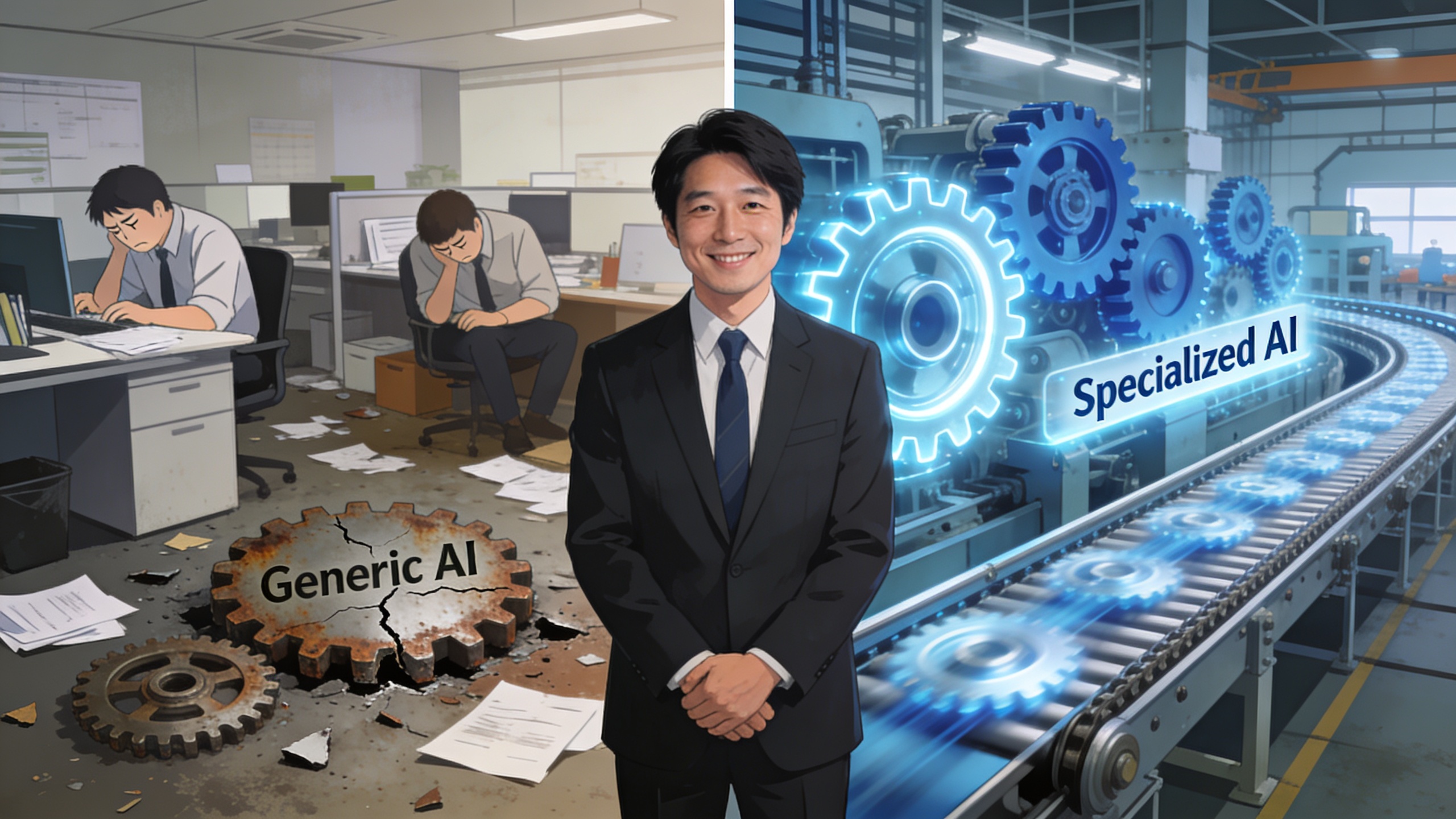
- “We Implemented AI, but Got No Results” – The Problem Lies in General-Purpose Models
- The Limits of General-Purpose AI: Three Walls ChatGPT Can’t Break
- kintone AI Shows “Field-Driven” AI Implementation
- Three Actions Executives Should Take Now
- Conclusion: The Essence of AI Implementation is a Shift to “Business Specialization”
“We Implemented AI, but Got No Results” – The Problem Lies in General-Purpose Models
“I introduced ChatGPT, but work efficiency hasn’t changed.” “We got stuck at the POC stage and never went live.” I’ve been hearing these complaints from business leaders more and more often.
An article in JBpress, “Why Do Corporate AI Implementation Projects Fail?” identifies three common patterns of failure. Meanwhile, NEC is clearly articulating a winning strategy of “specialization” that ChatGPT and Claude cannot achieve, positioning it as “AI that can truly be used for national and business purposes.”
In this article, drawing on these latest news, I’ll explain why general-purpose AI can’t solve real-world business challenges and why shifting to “business-specific AI” is crucial, using concrete examples.
Three Common Patterns in Failed Cases
According to JBpress’s analysis, corporate AI implementation failures fall into three patterns:
1. **”Let’s Just Implement It” Syndrome**: Introducing ChatGPT company-wide without a clear purpose, leaving it unused.
2. **The “Accuracy Obsession” Trap**: Pursuing only AI response accuracy while neglecting alignment with actual workflows.
3. **Perpetuating “Individual Dependency”**: Even after introducing AI tools, failing to establish operational rules and data maintenance, resulting in use by only a few employees.
From my experience supporting over 38 IT implementations, I can say these are not “tool problems” but “design philosophy problems.”
The Limits of General-Purpose AI: Three Walls ChatGPT Can’t Break
NEC’s article highlights three areas where general-purpose LLMs like ChatGPT and Claude fall short:
1. **Domain-Specific Accuracy**: In fields requiring specialized knowledge like finance, healthcare, and law, general models have limitations.
2. **Security and Compliance**: Many cases prevent sending confidential data to external clouds.
3. **Real-Time Responsiveness and Controllability**: Integrating into business processes requires strict control over response speed and output format.
This aligns perfectly with the concerns I often hear from clients: “I want ChatGPT to review contracts, but I’m afraid of data leaks.” “I want it to learn from our internal historical data, but I don’t know how.”
The “Specialization” Winning Strategy: Lessons from NEC
NEC’s “cotomi” is an LLM specialized in Japanese business documents. The company emphasizes the following differentiators as “things ChatGPT and Claude cannot do”:
– High-accuracy generation of Japanese honorific expressions and business document formats
– Ability to learn industry-specific terminology and abbreviations
– Operable in on-premises environments (meeting security requirements)
This holds extremely important implications for executives. “Specialization” doesn’t just mean “higher accuracy”; it refers to the high level of practicality that allows integration into business processes.
kintone AI Shows “Field-Driven” AI Implementation
Cybozu’s announced “kintone AI” official version (launching June 2025) perfectly embodies this “specialization” concept.
kintone is a no-code platform for creating business applications. By integrating AI capabilities, it enables field-driven AI utilization like:
– Automatic summarization and analysis of daily sales reports
– Automatic classification of customer inquiries and generation of response candidates
– Anomaly detection in inventory management and alert notifications
The key point is that these can be achieved “without programming.” Even without executives issuing a “Let’s implement AI” directive, an environment is emerging where field leaders can proactively integrate AI into their work.
Actual Implementation Costs and Estimated Effects
The monthly cost of kintone AI is currently estimated at several hundred to several thousand yen per user. In contrast, my estimates for clients show that summarizing daily sales reports can save 5 to 10 hours per person per month.
For example, if a sales team of 10 people adopts it, the annual cost is approximately ¥100,000 to ¥300,000 (roughly $700 to $2,100). The potential reduction in labor costs is ¥1,000,000 to ¥2,000,000 annually (roughly $7,000 to $14,000). The ROI is simply calculated at 3 to 10 times.
Three Actions Executives Should Take Now
Based on these news items, I present three actions executives should take immediately.
Decide the Shift from “General-Purpose AI” to “Specialized AI”
First, classify your company’s tasks into “areas where general-purpose AI is sufficient” and “areas requiring specialized AI.”
Based on my experience, the following criteria are effective:
– **OK with General-Purpose AI**: External document creation, brainstorming, simple data analysis
– **Requires Specialized AI**: Contract review, document creation with industry-specific terminology, tasks handling confidential data
Create an Environment “the Field Can Use”
Consider tools like kintone AI that can be introduced in a field-driven manner. The key is whether the design allows “field leaders to proactively figure out how to use it.”
In my own company, we use both Claude Code and ChatGPT to automate contract reviews and social media posts. From this experience, I can say that the success of AI implementation depends on “how well the tool integrates into the field’s workflow.”
A Checklist to Avoid the “Three Failure Patterns”
Finally, before starting an AI implementation project, review the following checklist:
– Is the implementation purpose clearly defined as “what problem are we solving”?
– Are the “success criteria” for the target task defined numerically?
– Is there a plan for operational rules and data maintenance?
– Are field leaders involved?
– Does the environment meet security requirements?
Conclusion: The Essence of AI Implementation is a Shift to “Business Specialization”
In 2025, generative AI is moving from the “let’s try it” stage to the “integrate it into business” stage. NEC’s “specialization” strategy and kintone AI’s “field-driven” approach symbolize this trend.
What is required of executives is not “which AI to choose,” but a shift in design philosophy: “how to specialize AI for our own business.”
In my own company, we generate approximately ¥7,500,000 (roughly $52,500) worth of value annually with a monthly AI cost of about ¥21,000 (roughly $147). This figure is not exceptional. With the right design philosophy and appropriate tool selection, any company can replicate this.
As a next step, why not start by identifying your company’s “tasks to specialize”?

Comments