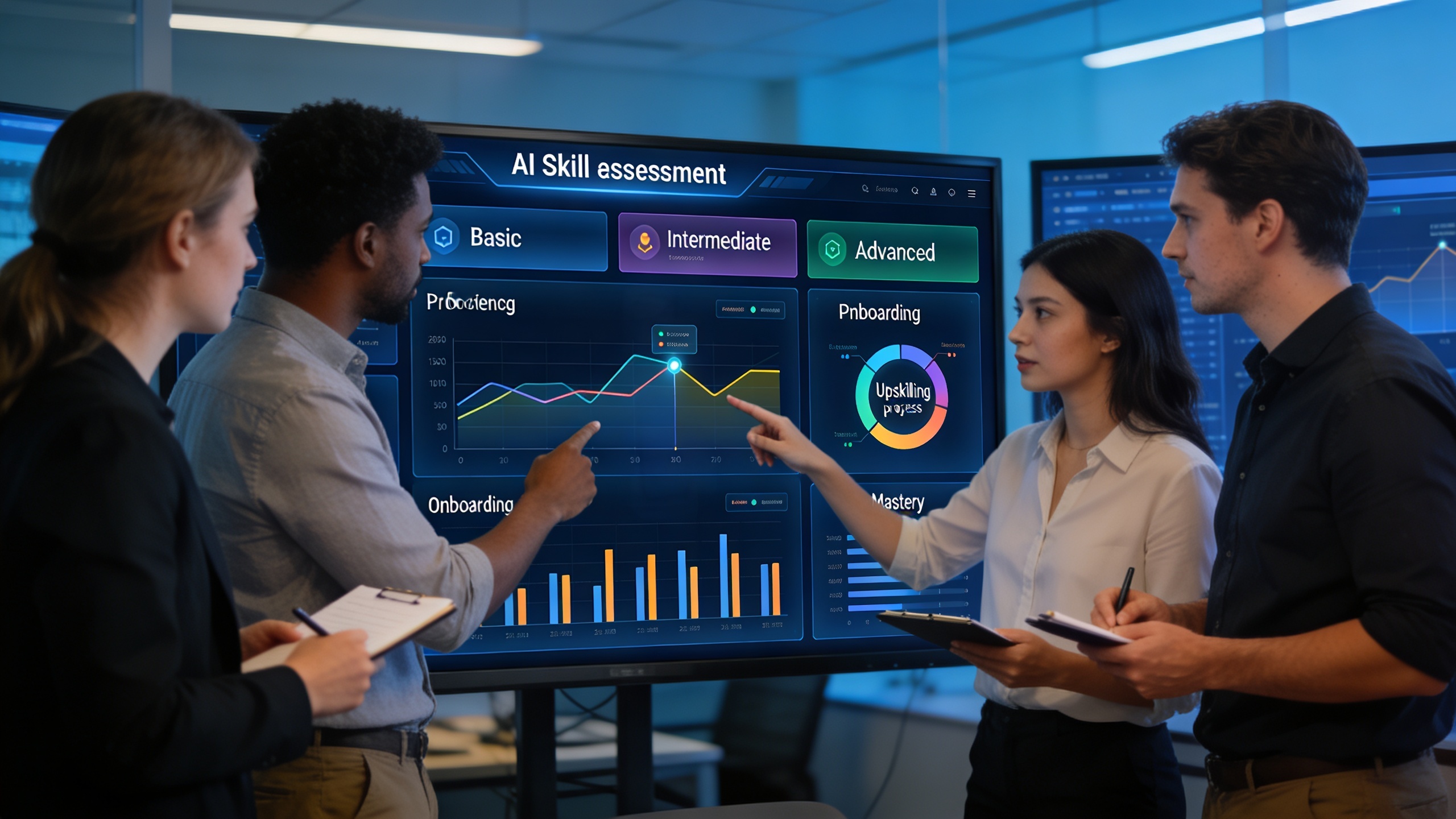
Making AI Skills Visible: A New Management Challenge
As generative AI rapidly expands into business operations, a key headache for executives is: “How do we evaluate and develop our employees’ AI skills?”
Recently, a “Generative AI Skills Test” was launched to assess practical AI proficiency. At the same time, Google began offering hands-on AI training programs for individuals, small businesses, and the public sector.
These developments signal a shift from the “adoption phase” to the “embedding and sophistication phase” of AI. This article offers strategic insights for executives, CTOs, and back-office leaders on how to approach AI skills evaluation and development.
What the “Generative AI Skills Test” Reveals
This test is not just a knowledge quiz. It uses scenario-based assessments to measure prompt engineering, output evaluation, and the ability to apply AI to real tasks.
In my AI consulting work, I’ve seen a huge gap between “being able to use ChatGPT” and “delivering results with it.” Many companies say, “We did AI training, but no one uses it on the job.”
The test’s value lies in objectively visualizing each employee’s practical AI level. This enables key management decisions:
Creating a Skills Map
By understanding AI proficiency by department and role, you can pinpoint where to invest in training. For example, customer support and marketing teams need different AI skills.
Prioritizing Training
One-size-fits-all AI training is inefficient. You can create tiered plans: basics for low-level employees, advanced prompt design and workflow integration for intermediates.
Defining Hiring Standards
Quantify the AI skills you need for new hires. Setting a concrete benchmark like “Level 3 or above on the Generative AI Skills Test” prevents hiring mismatches.
Google’s AI Training Program: Implications for SMEs
Google’s new program supports practical AI skill acquisition for individuals, SMEs, and the public sector. The “SME focus” is especially noteworthy.
Unlike large companies, most SMEs lack dedicated AI talent or IT departments. Google’s program is practical for these reasons:
Free or Low-Cost to Start
Google’s programs are often free, keeping initial investment low. Before spending thousands on AI tools, it’s an effective way to boost employee AI literacy.
Curriculum Tied to Real Work
It teaches practical use within Google Workspace (Gmail, Docs, Sheets)—tools many SMEs already use. This lowers the adoption barrier significantly.
Ripple Effects in the Public Sector
The public sector program can support local government DX initiatives. Expect concrete examples of AI applied to tasks like grant applications and citizen services.
Three Actions for Business Leaders
Here are three concrete steps you can start today:
Step 1: Visualize Current AI Skills
First, assess your company’s AI proficiency. Using an objective tool like the “Generative AI Skills Test” is efficient. The cost is roughly tens of dollars per test, so testing all employees is manageable.
In my experience, even when leaders think “our staff knows AI,” tests often reveal issues like “poor prompt quality” or “blindly trusting outputs.”
Step 2: Create a Tiered Development Plan
Based on skill levels, consider this plan:
Beginners: Google’s AI program or basic ChatGPT training. Tool costs of around $30–$100 per month are sufficient.
Intermediate: Job-specific prompt design, using multiple tools like Claude and Grok. Internal study groups sharing success stories are also effective.
Advanced: API integration and building automation pipelines. If you lack in-house AI engineers, consider external AI consultants.
Step 3: Link Evaluation to Rewards
Incorporate AI skill acquisition into your evaluation system to boost learning motivation. For example, offer a monthly skill bonus of around $35 for employees achieving Level 3 or above on the test.
In one company I consulted for, adding AI skills to promotion criteria tripled AI adoption rates in six months. The cost was just the skill bonus, with a very high ROI.
Beyond AI Skills Assessment
We’ve covered concrete methods for evaluating and developing AI skills. Finally, let’s consider the core value of this effort.
AI skills assessment isn’t just about test scores. It’s a management strategy to elevate your organization’s overall AI capability, boosting efficiency and competitiveness.
In my own company, AI has saved about 1,550 hours annually, achieving a 2,989% ROI. This success stems from visualizing and continuously developing each employee’s AI skills.
Generative AI’s evolution won’t stop. That’s why now is the time to build a system for evaluating and nurturing AI talent—it will be key to future growth.
The “Generative AI Skills Test” and Google’s programs are perfect first steps. Why not start small and visualize your company’s AI proficiency level?

Comments