- The Seismic Shift “Agent-Type AI” Brings to SMEs
- The Value of Industry-Specific Solutions That “Generic AI” Can’t Provide
- How Agent-Type AI Transforms Business Processes
- SMEs Can Differentiate Themselves with “Industry-Specific” Solutions
- Points to Note and Cost Considerations for Implementation
- Summary: What Business Owners Should Do Now
The Seismic Shift “Agent-Type AI” Brings to SMEs
The use of generative AI is moving from the “ask a question in a chat” phase to the “autonomously execute tasks” phase. As of December 2025, data shows that domestic generative AI implementation cases have reached 1,252, with a rapid increase in “agent-type” cases.
This trend holds immense significance for business owners. Why? Because AI agents are not just information retrieval tools; they can automatically execute multiple business processes and even make decisions. This technological evolution is creating new options for SME digital transformation (DX).
This article, based on the latest news, explains specific strategies for how SMEs should leverage AI agents.
The Value of Industry-Specific Solutions That “Generic AI” Can’t Provide
Anthropic’s “Claude for Small Business” is an AI agent service tailored for SMEs. However, what I find more noteworthy is the trend of “industry-specific ERP × generative AI × RPA.”
In industries with remaining analog workflows, such as construction, manufacturing, and welfare, industry-specific ERPs combining generative AI and RPA are emerging. This is a different dimension from simply introducing a chatbot.
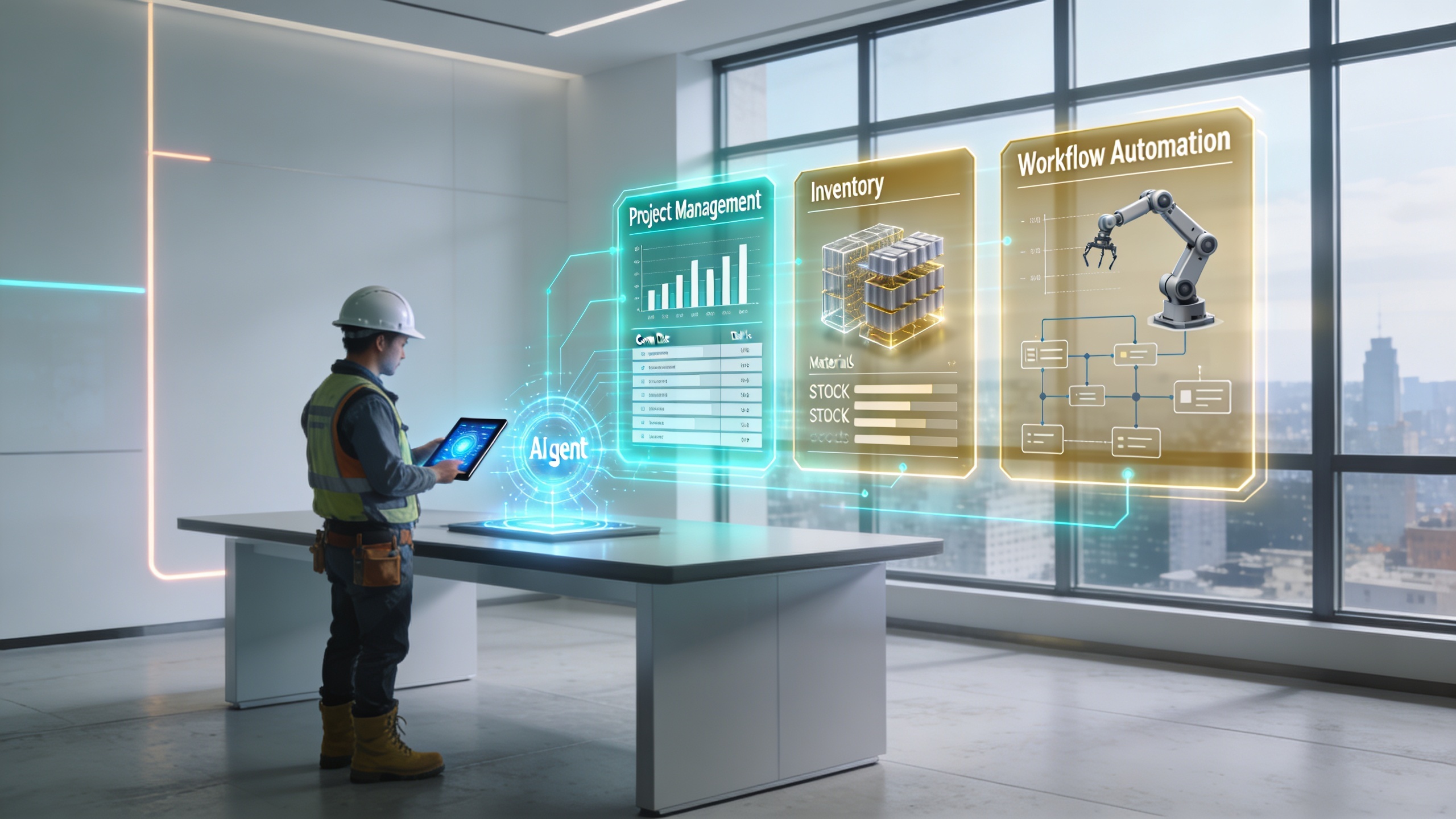
For example, in construction, AI can automatically assess progress from site photos and generate estimates and invoices. In the welfare sector, it can automatically create legally compliant reports from care records. This kind of “automation that understands the business context” is becoming a reality with agent-type AI.
From my experience supporting IT implementation for over 38 clients, I can say that “generic AI tools” are difficult for SMEs to master. I’ve heard countless times, “We introduced it, but we don’t know what to use it for.”
How Agent-Type AI Transforms Business Processes
According to updates in the generative AI implementation case database, agent-type cases are on the rise. Specifically, the following tasks are being automated:
・Analyzing customer inquiries, determining automatic replies or escalation
・Collecting data from multiple systems and automatically generating reports
・Autonomously managing schedules and tasks
These are characterized by AI taking over tasks involving “judgment,” in addition to traditional RPA (routine task automation). For example, in handling inquiries, AI analyzes the content, sends automatic replies for simple ones, and routes complex ones to the appropriate staff. By having AI make this “routing decision,” humans can focus on more complex work.
In my own company, we’ve built an agent system using both Claude and ChatGPT, automating everything from social media posts and contract reviews to FX trading. At a monthly cost of approximately $140 (21,000 JPY), we estimate we’re generating value equivalent to about $50,000 (7.5 million JPY) annually.
SMEs Can Differentiate Themselves with “Industry-Specific” Solutions
The key point here is that the approach to AI implementation differs between large corporations and SMEs. Large companies have the resources to build a generic AI foundation and customize it for each department. SMEs lack both the resources and the time.
This is precisely why “industry-specific” AI solutions are effective. An AI that has already learned the workflows, regulations, and customs of a specific industry can significantly reduce post-implementation adjustment costs.
For example, an AI agent for the construction industry can automate the following tasks end-to-end:
・Progress management through AI analysis of site photos
・Automated material ordering (AI judges based on inventory and schedule)
・Compliance checks and automatic report generation
Attempting to systemize these tasks individually would require investments of millions of yen and several months of development. However, with industry-specific AI agents, some cases can be implemented for a few tens of thousands of yen per month.
Points to Note and Cost Considerations for Implementation
When considering the introduction of AI agents, business owners should keep three key points in mind.
First is “data preparation.” AI agents improve accuracy by learning from past business data and manuals. Before implementation, you need to organize which data to feed the AI.
Second is “starting small.” I recommend not trying to automate all tasks at once, but starting with one business process. For example, starting with relatively routine tasks like part of the accounting work or customer inquiry handling tends to result in fewer failures.
Third is “redefining the human role.” As AI handles more judgment-based tasks, humans will be required to “verify whether the AI’s judgment is correct.” Especially in tasks involving responsibility, such as legal compliance and customer service, human oversight is essential.
In terms of cost, based on my own company’s example, you can start from about $140 (21,000 JPY) per month. Even for industry-specific solutions, the market price is settling around $330 to $670 (50,000 to 100,000 JPY) per month. Compared to the labor cost of one employee, this offers a sufficient return on investment.
Summary: What Business Owners Should Do Now
Generative AI is evolving from the era of “asking questions in a chat” to the era of “autonomously executing tasks.” And this evolution represents a huge opportunity, especially for SMEs.
There’s no need to build a massive AI infrastructure like large corporations. The era has arrived where you can introduce an AI agent tailored to your industry for a few tens of thousands of yen per month.
As a business owner, here are three things you should do now:
・Identify the parts of your business processes that can be delegated to AI
・Research vendors offering industry-specific AI solutions
・Start with a small success and gradually expand the scope of application
AI agents are powerful allies for SMEs struggling with labor shortages. However, it’s not just about implementation; the key is a mindset of continuous improvement through use. I myself constantly update how I integrate AI into my work.
Instead of “having your job taken by AI,” aim to “use AI to enhance the quality of your work.” Why not take that first step with this perspective in mind?

Comments