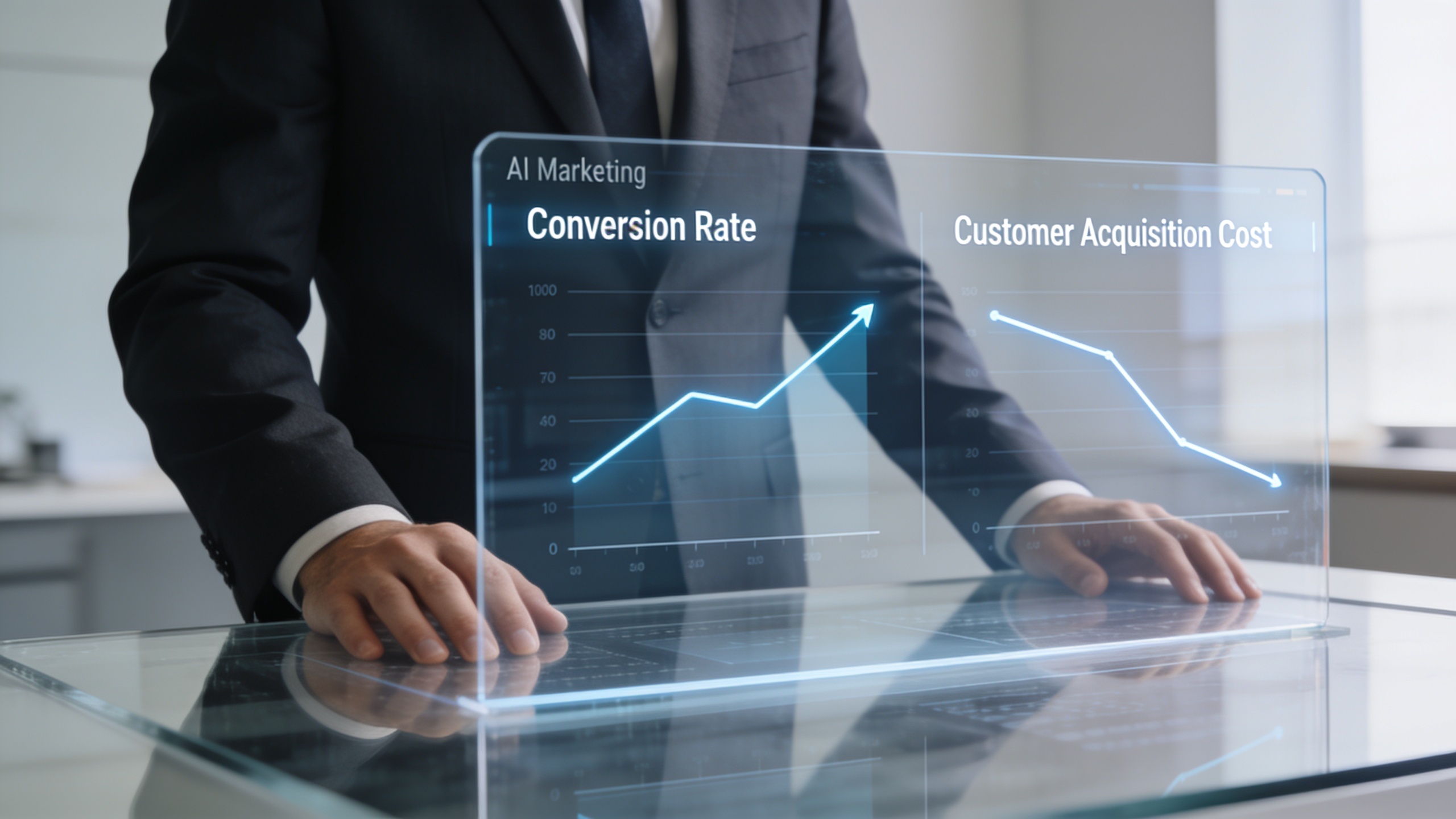
AI Marketing Effects Are Now Quantifiable
A survey has revealed that approximately 40% of companies using AI marketing tools have seen an increase in conversions. As web operations become more efficient, AI in marketing is steadily delivering results.
However, behind this figure lies a harsh reality: more than half of companies have yet to experience any tangible benefits. What business leaders must understand is that AI marketing is a “means,” not an “end.”
This article, based on the latest survey data, explains the specific conditions for achieving results with AI marketing and the management challenges that emerge after implementation.
Current State of AI Marketing Adoption and Its Real Effects
The survey revealed that about 40% of companies that adopted AI marketing tools reported an increase in conversions. At the same time, concrete benefits in web operations—such as reduced time for content creation and customer analysis—were also reported.
From my own experience implementing AI in our marketing operations, I can say that AI-driven efficiency gains fall into two categories: areas where results appear quickly and those that take time.
For example, routine tasks like automated social media posting or drafting email newsletters show results within a week of implementation. On the other hand, customer behavior analysis and segmentation optimization require data accumulation and model tuning, so you should expect about three months before seeing results.
The Gap Between Companies That See Results and Those That Don’t
Why do about 60% of companies fail to see results? Based on my consulting experience, I believe there are three main factors.
The first is “unclear implementation goals.” When introducing an AI tool without a clear target—like “what do we want to improve and by how much”—it becomes impossible to measure effectiveness, and you end up just “using it” without purpose.
The second is “insufficient data quality and quantity.” AI lives on data. Without well-organized historical customer and purchase data, AI analysis accuracy won’t improve.
The third is “inadequate operational structure.” Even if you introduce an AI tool, its effectiveness is halved without the personnel and systems to operate and improve it. Especially in small and medium-sized enterprises, it’s common for staff to manage AI as a side duty, leaving insufficient time for it.
Three Conditions for Achieving Conversion Growth
So, what are companies that actually increase conversions doing? Based on my practical experience and client cases, I’ve identified three common conditions.
Condition 1: Integrate and Cleanse Customer Data
The biggest factor affecting AI marketing accuracy is data quality. Companies that achieve conversion growth first integrate their customer data, cleaning up duplicates and gaps.
For example, this involves linking CRM, MA tools, and social media data to unify records for the same customer. This process takes about one to two weeks, but doing it carefully dramatically improves AI analysis accuracy.
In terms of cost, data integration tools cost around $350–$700 per month, and including labor, you should budget an initial investment of about $2,000–$3,500.
Condition 2: Start Small and Accelerate the PDCA Cycle
Instead of rolling out company-wide immediately, a more effective approach is to introduce AI marketing for a specific product or customer segment and verify the results.
For one of my clients, we introduced AI focused solely on “reactivating dormant customers.” The AI analyzed a list of customers who hadn’t purchased in the past year and automatically generated the best approach methods. As a result, the conversion rate improved by 15% in just two months.
The key is to analyze why results occurred and rapidly cycle through a PDCA loop to apply those insights to the next step. By measuring and improving results weekly for three months, you’ll steadily build up success.
Condition 3: Divide Roles Between Human Judgment and AI
One common mistake in AI marketing is “leaving everything to the AI.” AI is only meant to provide data-based suggestions; final decisions must be made by humans.
Specifically, an effective process is to have experienced sales staff review and adjust the customer lists and approach plans generated by AI. This “AI × human” hybrid setup is the key to increasing conversions.
The Next Management Challenge After AI Marketing
Once AI marketing starts producing results, business leaders face the next challenge: a strategic decision about where to allocate the resources freed up by AI-driven efficiency.
In my own company’s case, AI-powered marketing automation saved about 50 hours of work per month. I’ve redirected this freed-up time to “planning new business ventures” and “in-house development of AI systems.”
What’s particularly important is the decision to move away from relying on SaaS for AI tools and instead develop systems optimized for your own company. As AI marketing adoption progresses, the need for customization tailored to your specific business model increases.
For example, if you need special customer segments or unique KPI settings that standard MA tools can’t handle, in-house development becomes a realistic option.
Decision to Shift to In-House Development and Cost Estimates
In-house development requires an initial development cost of about $7,000–$21,000 and monthly operational costs of around $700–$1,400. On the other hand, for companies paying $2,000–$3,500 per month for SaaS, the investment can be recouped within a year.
I recommend the following three criteria for deciding on in-house development.
First, “do you need features specific to your business model?” If general-purpose features are sufficient, continuing with SaaS is more rational.
Second, “data confidentiality.” If you’re concerned about entrusting customer and purchase data to an external service, in-house data management is effective.
Third, “long-term cost estimates.” When looking at operations over three years or more, in-house development often results in lower total costs.
Summary: The Essence of AI Marketing Success Lies in Management Decisions
To achieve conversion growth with AI marketing, simply introducing a tool is not enough. You need management-level decisions involving data preparation, building operational structures, and dividing roles between humans and AI.
And once results start appearing, you should consider the strategic option of “establishing a competitive advantage through in-house development” as the next step. AI marketing is no longer just for pioneering companies; it’s now feasible even for small and medium-sized enterprises.
The first step to success is for business leaders themselves to take stock of their company’s data assets and decide which area to start implementing AI.


Comments