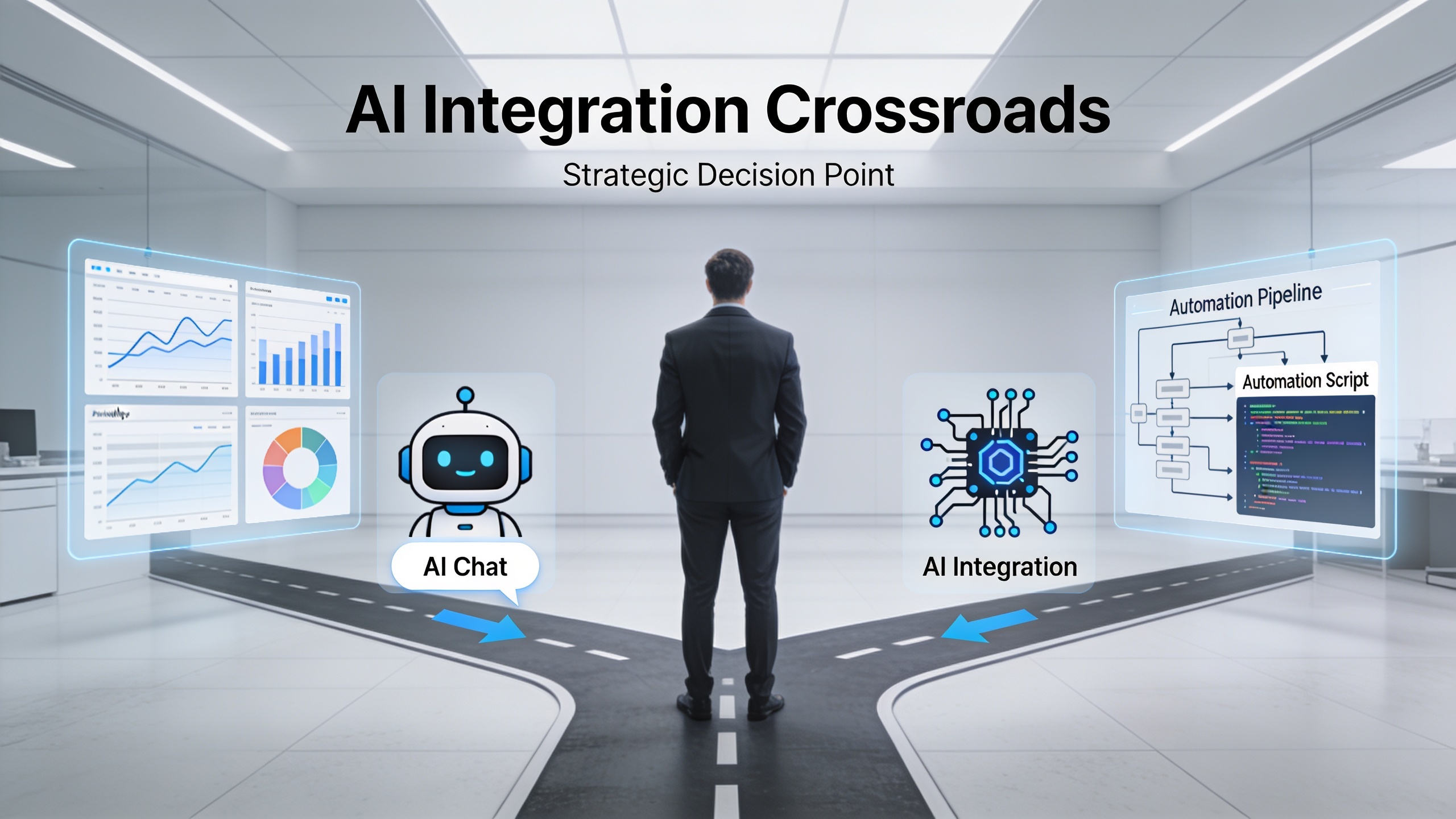
The Structural Problem of Organizations That Just “Use” Generative AI
Recent surveys show that organizational use of generative AI has reached 80%. However, they also reveal that one in three people are not leveraging it for core business tasks. In other words, many companies are “using it, but not maximizing its impact.”
Another survey found that about 60% of employees in companies with over 1,000 workers are using AI. Adoption rates are lower in smaller companies, highlighting a significant gap based on company size. These numbers suggest that even large corporations are experiencing a polarization between “departments that use AI” and “those that don’t.”
From my experience supporting AI adoption for over 38 clients, I can say that “introduction” and “integration” are completely different phases. Even if you distribute ChatGPT or Claude accounts company-wide, if employees only use them for summarizing emails or taking meeting minutes, the ROI will be limited.
Why the Shift from “General Tasks” to “Core Business” Isn’t Happening
The Biggest Barrier: The Perception Gap Between Frontline and Management
There are three main reasons why generative AI adoption remains stuck on “general tasks.”
First, management often sees AI as a “productivity tool.” Yes, using AI for general tasks like writing emails or drafting documents can save time. But that alone won’t differentiate you from competitors.
Second, frontline workers have a vague fear of “losing their jobs to AI.” Especially when AI is introduced into core tasks like planning and analysis, some employees resist, worrying that “my judgment will become unnecessary.”
Third, there are no concrete use cases within the company. Even if people understand “what ChatGPT can do,” they haven’t figured out “how to apply it to our core business.”
Why Even Companies with Over 1,000 Employees Are Stuck at 60%
The figure of “60% AI adoption in companies with over 1,000 employees” might seem low at first glance. However, in my experience, the larger the company, the greater the discretion of individual departments, making company-wide AI adoption challenging.
For example, the legal department might introduce AI for contract review, but the sales department might decide “AI isn’t needed for face-to-face meetings.” HR might use AI for initial resume screening, but accounting might hold back due to “concerns about accuracy.” These varying temperatures across departments drag down the overall company-wide AI adoption rate.
Three Concrete Strategies for Integrating AI into Core Business
Start with “Task Decomposition” for AI Design
The first step to introducing AI into core business is to break down tasks into “task-level” components. For example, the task of “developing a marketing strategy” can be broken down into “market research,” “competitive analysis,” “target setting,” “KPI design,” and “action planning.” Then, identify which of these tasks AI can be most effective for.
With my clients, I conduct workshops where management and frontline staff perform this task decomposition together. In most cases, this is the first time they realize that “our core business is actually made up of several routine tasks.”
As for specific tools, using Claude’s project feature or ChatGPT’s custom GPTs to create AI assistants specialized for specific workflows is effective. Monthly costs range from about $20 to $130, making the barrier to entry relatively low.
Overcoming “Accuracy Concerns” with a Verification Process
Surveys also cite “concerns about accuracy” as a barrier to AI adoption. It’s true that generative AI can’t completely prevent hallucinations (generating false information). However, precisely because it’s used for core business, it’s crucial to design a human verification process into the workflow.
For example, my firm uses a two-step process where a lawyer always reviews the contract review results generated by AI. By having humans check only the clauses that AI flagged as “high risk,” we’ve reduced review time by 70% while maintaining accuracy.
By clearly defining “role sharing between AI and humans” rather than “leaving it to AI,” concerns about accuracy can be significantly reduced. In the early stages of adoption, it’s practical to enforce a rule that “humans must always verify AI output” and accumulate reliability data.
Internal Training Programs to Increase the Number of “AI-Capable” People
To break through the barriers to AI adoption, you need to move from a state where only specific IT staff can use it to a state where all employees use it daily. For this, a phased training program is effective.
Start with “AI literacy training” to teach the basics, then hold “department-specific use case sharing sessions” to spread successful examples from other departments. Additionally, internal events like “AI utilization contests” can be effective for generating frontline-driven ideas.
At one mid-sized company I supported, a staff member in the accounting department proposed “automating invoice journal entries,” resulting in a 20-hour monthly reduction in workload. This success story spread to other departments, and within three months, AI was introduced into five core business tasks. The key is to create a system that evaluates bottom-up adoption proposals, not just top-down directives.
Summary: Moving to the “Next Phase” of AI Adoption
Now that 80% of organizations are using generative AI, the challenge for companies is shifting from “using it” to “using it effectively.” To do this, you need to overcome three barriers: moving from general tasks to core business, bridging the temperature gap between departments, and dispelling concerns about accuracy.
In my own firm, with a monthly AI cost of about $140, we generate value equivalent to approximately $50,000 per year. We achieved this ROI by positioning AI not as a “productivity tool” but as a “resource to enhance the reproducibility of management.”
To all business leaders, I want to emphasize that the success of AI adoption depends not on the tool’s performance, but on the organization’s “usage design” and “cultural cultivation.” Why not start by breaking down your company’s core business into task levels and, together with your frontline staff, think about where AI should be integrated?


Comments