- The New Trend of Field-Led AI Development
- Key Success Factors of Field-Led AI from Kyushu Hitachi Systems
- Subsidies and Training Programs SMEs Can Use Right Now
- Achieving “Defensive DX” and “Offensive Sales” with Free AI
- Concrete Steps for Field-Led AI Adoption
- Reality of Costs and Adoption Barriers
- Conclusion: Return the Initiative for AI Adoption to the Frontline
The New Trend of Field-Led AI Development
When many business owners hear “AI adoption,” they often imagine outsourcing expensive systems to external vendors. However, recent news shows this conventional wisdom is rapidly changing.
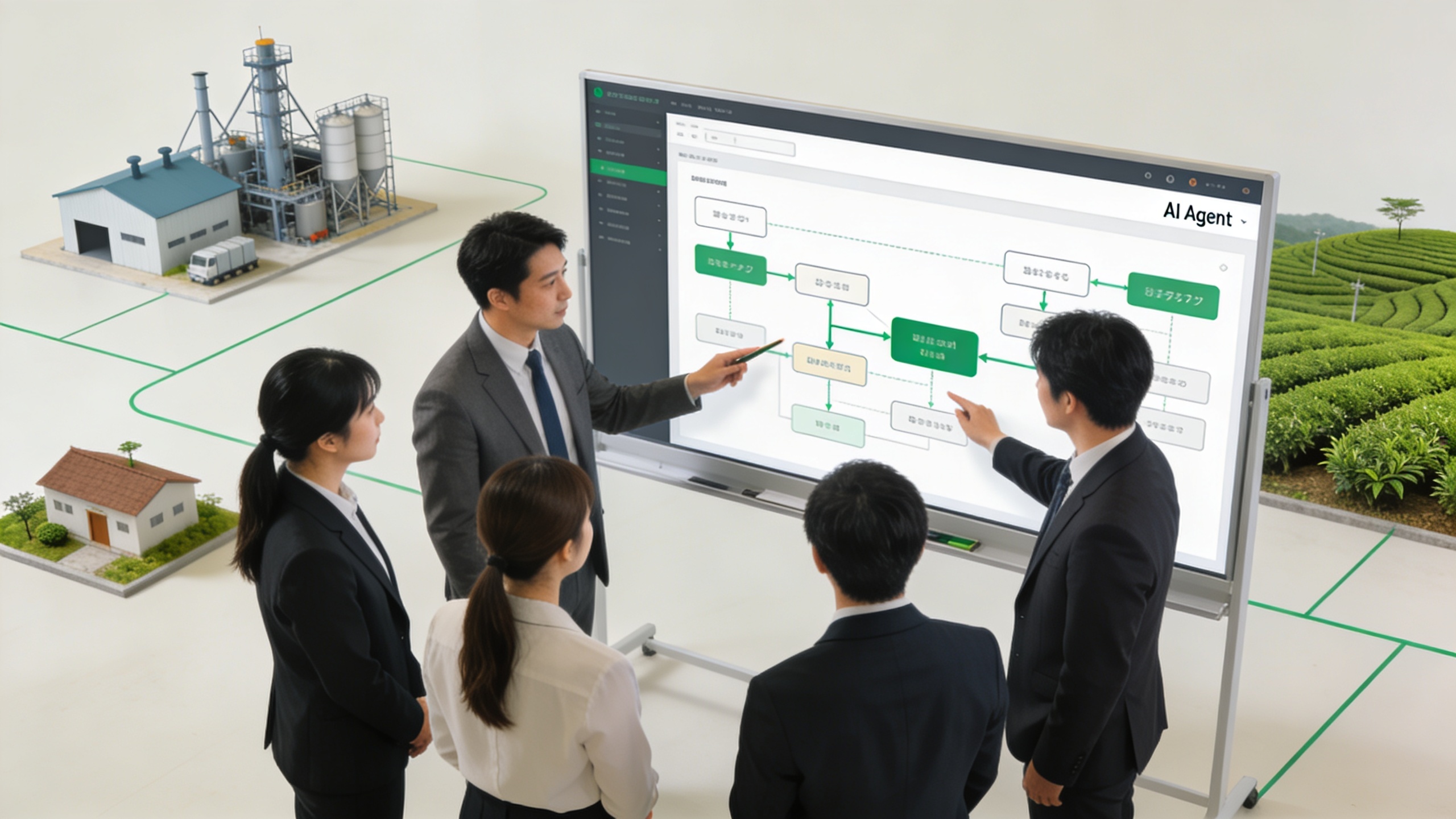
Kyushu Hitachi Systems introduced the “Tech Camp AI Utilization Support Service,” enabling on-site employees to build their own AI agents. The results were then rolled out company-wide, achieving significant operational efficiency. This shift indicates that the initiative for AI adoption is moving from “IT departments” to “frontline teams.”
At the same time, news that Paradis Inc. was selected as an IT implementation support provider for the “Digitalization and AI Adoption Subsidy 2026,” the case of Shizuoka’s Sasaki Tea transforming its sales strategy using free AI, and the official launch of the conversational AI customer support tool “DESKA” all point to a rapidly maturing environment for AI adoption among SMEs.
This article explores why “field-led AI adoption” is effective for solving management challenges in SMEs, along with specific methods, based on these latest trends.
Key Success Factors of Field-Led AI from Kyushu Hitachi Systems
The noteworthy aspect of the Kyushu Hitachi Systems case is that AI agent development was “field-led.” Traditionally, IT adoption involved management or IT departments defining requirements, with external vendors building the system. However, this approach often led to a gap between frontline needs and actual functionality, resulting in low post-implementation adoption rates.
In this case, by having frontline employees build their own AI agents, the following benefits emerged:
Direct Reflection of On-Site Knowledge into AI
Sales staff and back-office workers are intimately familiar with the “nuanced rules” and “tacit knowledge” of their jobs. Outsourcing to an external vendor requires significant effort to translate this tacit knowledge into a system, but a field-led approach eliminates this process.
From Small Successes to Company-Wide Rollout
Instead of building a large-scale system from the start, starting with one department or workflow minimizes risk. By rolling out these “small successes” across the company, Kyushu Hitachi Systems likely improved the organization’s overall AI literacy.
Significant Cost Reduction
Outsourcing to an external vendor can cost anywhere from several hundred thousand to several million yen (approx. $3,000 to $30,000+) for a single AI agent. However, a field-led approach can achieve sufficient results with AI tools costing just a few thousand to tens of thousands of yen per month (e.g., Claude Code or ChatGPT). I personally run 32 AI agents within my own company for a monthly cost of about 21,000 yen (approx. $140).
Subsidies and Training Programs SMEs Can Use Right Now
To achieve field-led AI adoption, you need in-house talent capable of building AI. This is where support systems from the government and companies come into play.
Leveraging the “Digitalization and AI Adoption Subsidy 2026”
The “Digitalization and AI Adoption Subsidy 2026,” for which Paradis Inc. was selected, is a government program that covers part of the cost for SMEs to introduce AI and digital tools. While specific subsidy rates and maximum amounts haven’t been released yet, similar past programs have provided subsidies ranging from 1 million to 3 million yen (approx. $7,000 to $20,000).
The key to using this subsidy is to apply with the goal of “improving business processes,” not just “introducing tools.” Since subsidy reviews emphasize post-implementation effect measurement and KPI setting, be sure to clarify “which tasks” will be streamlined and “by how much” beforehand.
Utilizing the “Tech Camp AI Utilization Support Service”
The “Tech Camp AI Utilization Support Service” adopted by Kyushu Hitachi Systems is a training program for frontline employees to build AI agents. Similar services are offered by multiple companies, such as Uravation’s “Claude Code Utilization Training Program.”
The advantage of these training programs is that even those with no programming experience can participate. Using no-code/low-code tools like Claude Code or ChatGPT, non-engineers can build AI agents. Training typically lasts 2 to 5 days, with costs ranging from 100,000 to 300,000 yen per person (approx. $700 to $2,000).
Achieving “Defensive DX” and “Offensive Sales” with Free AI
The case of Shizuoka’s Sasaki Tea demonstrates that even free AI tools can be highly effective. The company first solidified its “defensive DX” (operational efficiency) using free AI tools, then expanded into “offensive sales strategies” (new customer acquisition).
This “defense → offense” sequence is a golden rule for successful AI adoption in SMEs. We recommend starting with “defensive tasks” like the following:
Automating Inquiry Responses
Conversational AI customer support tools like the recently launched “DESKA” can be introduced for a few tens of thousands of yen per month (approx. $100-$200+). There are cases where AI automatically answers frequently asked questions (FAQs), reducing the time staff spend on inquiries by over 50%.
Automating Sales Material Creation
By building a system using ChatGPT or Claude to automatically generate customized proposal documents for each client, you can significantly reduce the time sales staff spend on document creation. In one of my client’s cases, implementing this system saved sales staff over 2 hours per day.
Concrete Steps for Field-Led AI Adoption
Here are the steps to actually implement field-led AI adoption.
Step 1: Inventory and Prioritize Tasks
First, list all your company’s tasks and prioritize those that meet three criteria: “high time consumption,” “relies on specific individuals,” and “has clear rules.” Examples include accounting, invoice processing, and customer data organization.
Step 2: Create a Prototype with Free Tools
Instead of jumping straight to paid tools, create a simple prototype using the free versions of ChatGPT or Claude. This stage is for verifying whether the task can truly be made more efficient.
Step 3: Conduct Training for Frontline Employees
Use training programs like “Tech Camp” or “Uravation” to equip frontline employees with the skills to build their own AI agents. It’s crucial that this training targets frontline staff, not management.
Step 4: Roll Out Small Successes Company-Wide
Expand successful AI agents from one department to others. Remember to customize them to fit each department’s specific tasks.
Reality of Costs and Adoption Barriers
The costs associated with field-led AI adoption are as follows:
- AI tool usage fees: 0 yen/month (free version) to approx. 21,000 yen (approx. $140, paid version)
- Training program costs: 100,000 to 300,000 yen per person (approx. $700 to $2,000)
- Out-of-pocket costs when using subsidies: Up to about one-third of the total cost
The biggest adoption barrier is “in-house AI literacy.” However, with training programs, even those with no programming experience can learn to build AI agents in just two days. Furthermore, subsidies can cover part of the training costs, further reducing the actual financial burden.
Conclusion: Return the Initiative for AI Adoption to the Frontline
As the Kyushu Hitachi Systems case shows, entrusting the initiative for AI adoption to the frontline allows you to build AI agents that meet on-the-ground needs while keeping costs down. With ample subsidies and training programs available, the environment is ripe for even SMEs to take on this challenge.
Many business owners think “AI adoption is too difficult,” but in reality, taking a “let our employees build it themselves” approach makes the process surprisingly smooth. Start by taking inventory of your company’s tasks and find just one that can be automated with AI. That small step will eventually lead to significant competitive advantage.

Comments