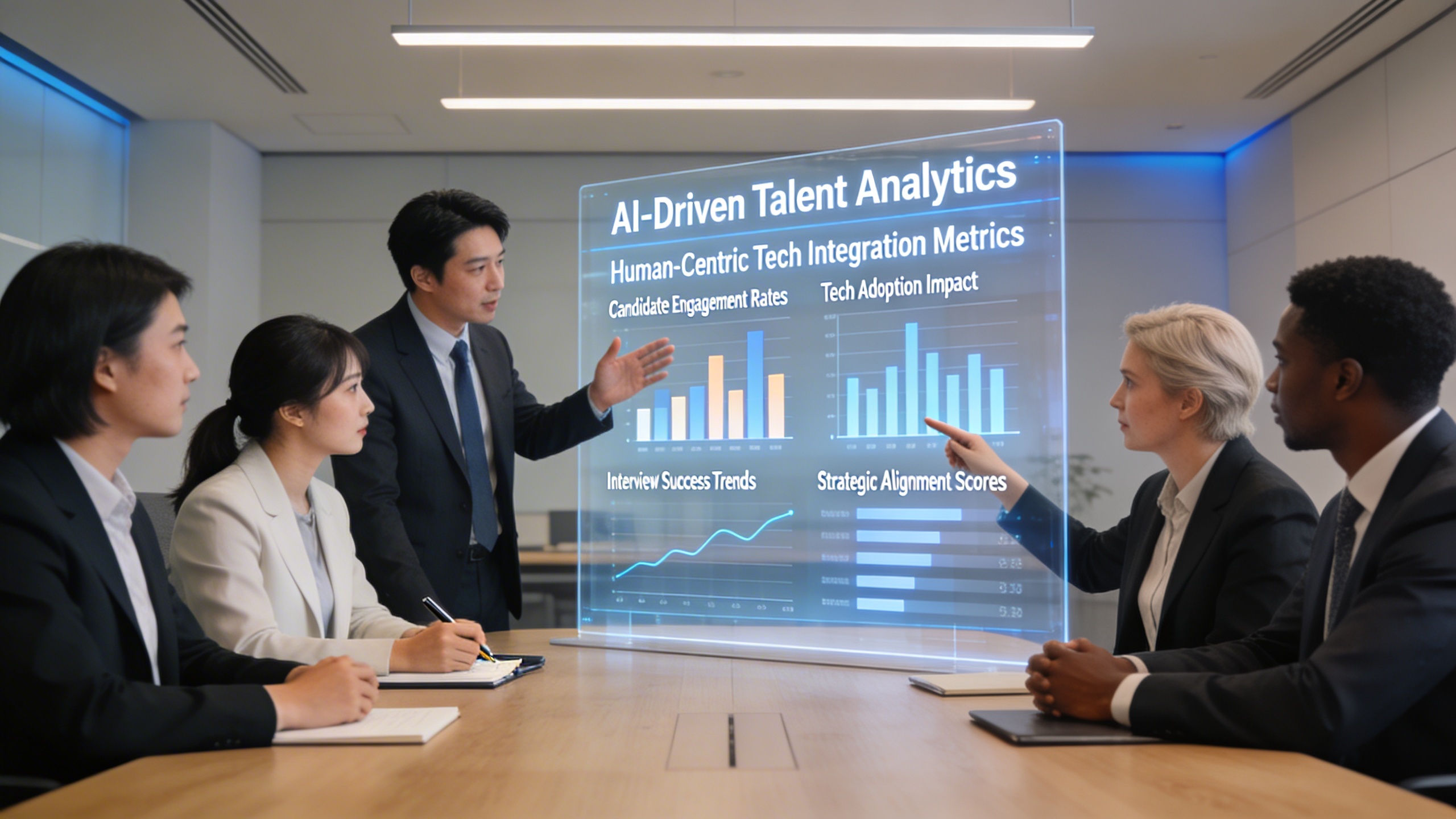
The Essence of AI Interviews is Not “Efficiency”
AI-powered job interviews are beginning to be fully implemented at major corporations. What prompted leading Japanese companies like Lawson and Kirin to introduce AI interviews? Beyond the “efficiency of interview tasks” or “cost reduction” that many executives imagine, there lies a deeper strategic intent.
According to reporting by Business Insider Japan, Lawson introduced AI interviews starting in April 2023, and Kirin in 2022. However, both companies explicitly state that “efficiency” was not their primary goal for implementation. So, why did they undertake significant investment and organizational reform? The answer lies in “how to identify talent” and “organizational transformation” in the AI era.
The “True Value” of AI Interviews as Seen by Lawson
Behind Lawson’s introduction of AI interviews was a fundamental issue with the traditional interview process: the limitations of “evaluations dependent on the interviewer’s experience and intuition.” Human interviewers inevitably struggle to escape tendencies to favor certain types of candidates (so-called “similarity bias”) or being influenced by first impressions (the “halo effect”).
Lawson’s HR personnel state that AI interviews have “eliminated interviewer habits and biases, enabling more objective evaluations.” The AI quantifies data such as a candidate’s speech patterns, changes in facial expression, and answer consistency. It visualizes latent abilities and aptitudes that are difficult for humans to notice.
The key point here is that the AI functions not as a “replacement for humans” but as a tool that “complements human judgment.” While the final hiring decision is still made by humans, the material for that judgment is enriched by AI, and biases are reduced. This is the primary value of AI interviews.
Kirin’s “DX Dojo” Implemented for All 3,800 Employees
Meanwhile, Kirin’s approach goes even further. According to a JBpress article, Kirin launched a company-wide training program named the “DX Dojo.” Approximately 3,800 employees learned how to utilize generative AI tools.
Behind this massive educational investment lies an intention that goes beyond simply learning how to use tools. Kirin aimed to reform the mindset of all employees, including “reluctant leaders.” By experiencing generative AI “hands-on,” they lowered psychological resistance to digital transformation and raised the overall IT literacy of the entire organization. This created the foundation for various AI implementations, starting with AI interviews.
In my own consulting experience, the biggest barrier to introducing AI tools is often not “technical understanding” but “psychological resistance.” Kirin’s “DX Dojo” can be considered an excellent model for systematically removing this psychological barrier.
Concrete Steps and Cost Considerations for Implementing AI Interviews
So, what steps are necessary to implement AI interviews in your own company? Also, what level of cost is involved?
A Three-Stage Implementation Approach
First, AI interview services can be broadly categorized into three types.
1. Platform-Type Services
Cloud services provided by HR tech companies. No in-house system development is required, allowing for relatively quick implementation. The typical range is approximately $630 to $3,150 per month (approx. 100,000 to 500,000 JPY), often with usage-based pricing depending on the number of candidates. Initial costs are around several hundred thousand yen.
2. Customized Solutions
A type that customizes the AI model according to your company’s hiring criteria and corporate culture. Initial development costs range from about $6,300 to $31,500 (approx. 1 to 5 million JPY), but it allows for evaluations optimized for your company.
3. In-House Development
A method of building the system in-house by connecting via API to foundational models like GPT-4 or Claude. Development costs depend on engineering man-hours, but this can be the most cost-effective option in the long run.
A Realistic First Step Even for SMEs
Implementing AI interviews company-wide does not require investments on the order of hundreds of millions of yen. Starting with a trial implementation for specific job categories or parts of the new graduate hiring process is a realistic approach.
The phased approach I propose to client companies is as follows.
Step 1: Clarify Evaluation Items
Clearly define in advance the items for the AI to evaluate. Define measurable abilities such as “communication skills,” “logical thinking ability,” and “problem-solving orientation.”
Step 2: Trial of Existing Services
Many HR tech companies offer free trials. First, actually try the services of 2-3 companies to verify if they meet your needs.
Step 3: Pilot Implementation
Limit implementation to one hiring project (e.g., mid-career engineer recruitment). Compare and verify the results of AI evaluations against human evaluations.
The Value of AI Interviews “Beyond Hiring”
The true potential of AI interviews lies beyond the efficiency of the hiring process. It is the construction of an “organizational talent database” and the “personalized optimization of development plans.”
Accumulation and Utilization of Talent Data
Data collected through AI interviews can also be utilized for post-hire talent development. By linking pre-employment ability assessment data with post-employment performance data, it becomes possible to build a model of “what kind of talent thrives in our company.”
This data-driven approach fundamentally changes traditional talent strategies based on “intuition and experience.” For example, quantified insights accumulate, such as the speech patterns of successful sales personnel or the characteristics of logical thinking required for engineers.
Personalized Optimization of Development Plans
The strengths and weaknesses revealed for each individual through AI interviews can be directly applied to post-hire development plans. Provide interpersonal skills training early to a new hire evaluated as having challenges in communication ability. Entrust more complex problem-solving tasks early to an employee whose strength is logical thinking.
This “integration of hiring and development” is a unique possibility enabled by AI. Relying solely on human interviewers made this level of detailed, data-based individual optimization practically difficult.
The “AI-Era Talent Strategy” Executives Should Consider
When considering the introduction of AI interviews, executives need to clarify the following three points.
1. Redefining Evaluation Criteria
What you have the AI evaluate reflects the company’s very values. It’s not just about “excellent talent,” but how you define “talent that can thrive at our company.” Confronting this fundamental question is the first step in introducing AI interviews.
As seen with Kirin’s company-wide generative AI education, the abilities needed in the AI era are changing. Beyond mere knowledge or skills, it may be necessary to establish new evaluation items like “the ability to collaborate with AI” and “adaptability to change.”
2. Division of Roles Between Humans and AI
AI interviews do not make human interviewers obsolete. On the contrary, it is crucial to design the optimal division of roles between humans and AI.
My proposal is a division of roles as follows.
AI’s Role: Screening from a large pool of applicants, collecting/analyzing objective data, ensuring consistency in evaluations.
Human’s Role: Final hiring decisions, assessing cultural fit, judging “human qualities” that AI cannot measure.
3. Ethical Considerations and Transparency
AI interviews also come with ethical challenges. Ensure that the AI’s decision criteria do not become a “black box” by making the basis for evaluations explainable. Also, regularly audit whether the data the AI learned from contains biases.
In Europe and the US, regulations concerning the use of AI hiring tools have already begun. Considering that similar regulations may be introduced in Japan in the near future, it is necessary to strive for transparent operation.
Concrete First Steps You Can Take Starting Tomorrow
Implementing AI interviews is not something that can be completed overnight. However, it is possible to start with small steps like the following.
1. Internal Awareness Sharing
First, create opportunities to discuss the potential and challenges of AI interviews not only within the HR department but also with executives and managers from various departments. Like Kirin’s “DX Dojo,” gaining understanding and buy-in is crucial first.
2. Research on Competitors & Industry Trends
Investigate what kind of AI hiring tools competitors in your industry are introducing. Participating in industry associations or HR tech conferences is also effective.
3. Small-Scale Proof of Concept
Try AI interviews not for actual hiring, but for selections like internal transfer applicants or internship candidates. This allows you to accumulate practical insights while keeping costs low.
AI interviews are not merely an update to hiring tools. They are an opportunity to re-examine the very “way of viewing talent” and “nature of the organization” in the AI era. As the examples of Lawson and Kirin show, only companies that discover strategic value beyond efficiency will be able to build a competitive advantage in the AI era.
Reflect on your own company’s hiring process and ask, “If AI were the interviewer, what would it evaluate?” That very question is the first step toward an AI-era talent strategy.

Comments